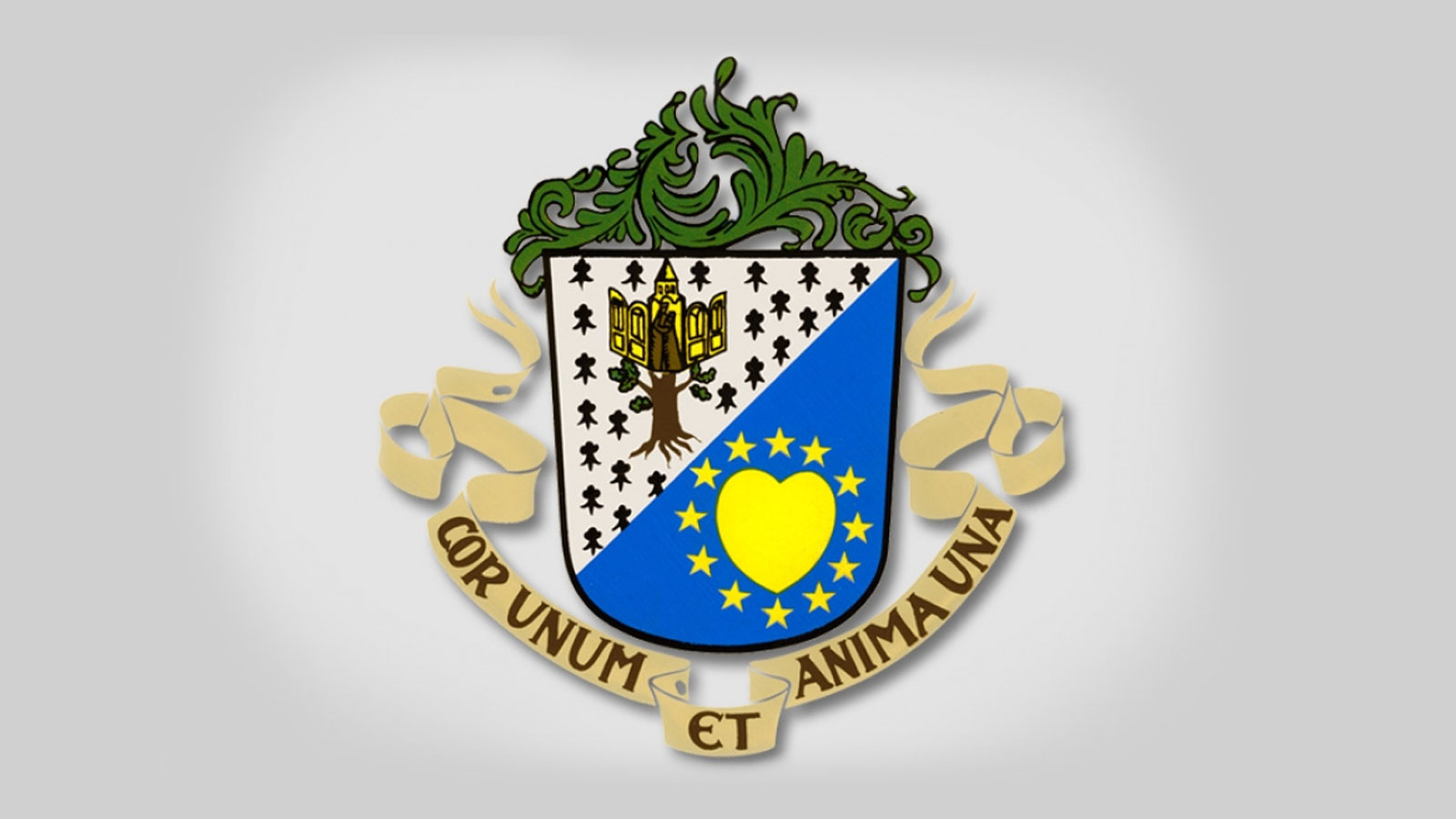
The Coat of Arms of the Congregation of the Immaculate Heart of Mary

Philippe de Rosen, cicm
Missionary in Belgium
The coat of arms is divided into two parts:
The upper part represents the tree with the Marian shrine, located in the 15th century along the road leading from Brussels to Ninove. It was there that the Virgin Mary appeared on Pentecost in 1450. The tree was in full bloom (in Dutch, boom schiet scheutjes: the tree sprouts "buds," which could be the origin of the name SCHEUT, previously a battlefield (schietveld) in 1356. Did Mary want to transform a place of death into a place of LIFE?
The lower part of the coat of arms alludes to the European flag, with the Immaculate Heart of Mary added.
"The European flag, with its twelve golden stars on a blue background, can be associated with a biblical interpretation, notably the vision of the Virgin Mary in the Apocalypse of Saint John. Arsène Heitz, the designer of the flag, was explicitly inspired by this passage where a woman crowned with twelve stars appears in the sky: Revelation 12:1: "A great sign appeared in the sky: a woman clothed with the sun, with the moon under her feet and a crown of twelve stars on her head."
Twelve stars: They symbolize perfection, fullness, and harmony, also recalling the twelve apostles, the twelve tribes of Israel, and the twelve months of the year.
Blue: The blue color of the flag represents the sky, the universe, and is also associated with the Virgin Mary, notably through the blue sapphire mentioned in the Apocalypse.
Symbolism of the European flag:

Union and harmony: The twelve stars forming a circle symbolize the union and cohesion of the European peoples.
Solidarity: The stars represent solidarity and harmony between European nations.
European values:
The flag embodies the fundamental values of Europe, such as peace, unity, and solidarity.
In summary, although often perceived as a secular symbol, the European flag has strong religious symbolism, drawing inspiration from Marian iconography and the Apocalypse of Saint John. (According to Croire-Publications and CVCE.EU.)
Has it not been the MISSION of CICM since its inception to bring this peace, unity, and solidarity wherever its members are sent? We want to believe in this and work with all men and women of goodwill throughout the world to make this dream of humanity, which is the dream of God Himself, come true.